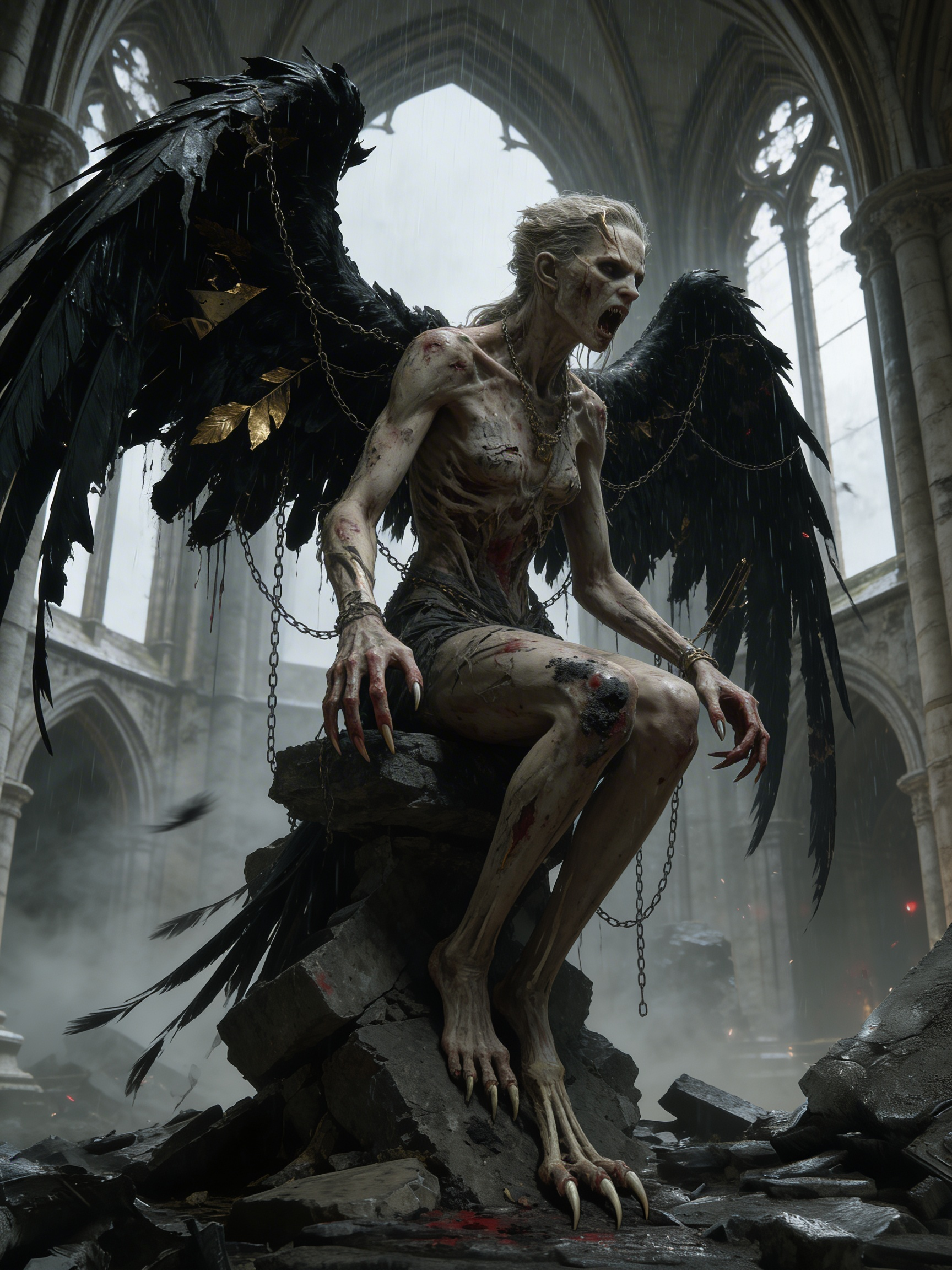
Overview
Physical Form
A face recognizably human — too human. Eyes that hold intent, not animal blankness. But the neck flows without interruption into the muscled torso of an enormous raptor. Talons at the ends of legs designed to grip stone or bone equally well. Wings so wide their opening blots out the sun in a narrow valley. The smell that precedes them: rotten wind and old iron. Their voices are screams shaped like words.
What They Are
In Hesiod (Theogony, 265–269) the Harpies — Aello ('storm-swift') and Ocypete ('swift-wing') — are daughters of Thaumas and Electra, sisters of Iris. In the Argonautica and the Aeneid they are punitive agents: set loose upon Phineus to foul his food and his sight. In Anatolian iconography they predate Hesiod entirely — carved bird-women on funeral stelae from 1200 BCE. In the Nephilim Chronicles cosmology they represent the outer edge of Watcher-era zoomorphic experimentation: beings that retained enough human cognition to be directed but enough predatory biology to be weaponized.
Capabilities
Flight speed exceeding any natural bird. The ability to produce winds by wingbeat — localized storm generation over short distances. The scream carries infrasonic frequencies that cause disorientation and nausea in humans within 40 feet. Talons pierce standard bronze armor. Their primary weakness: they cannot operate in complete calm; they require wind to navigate at speed.