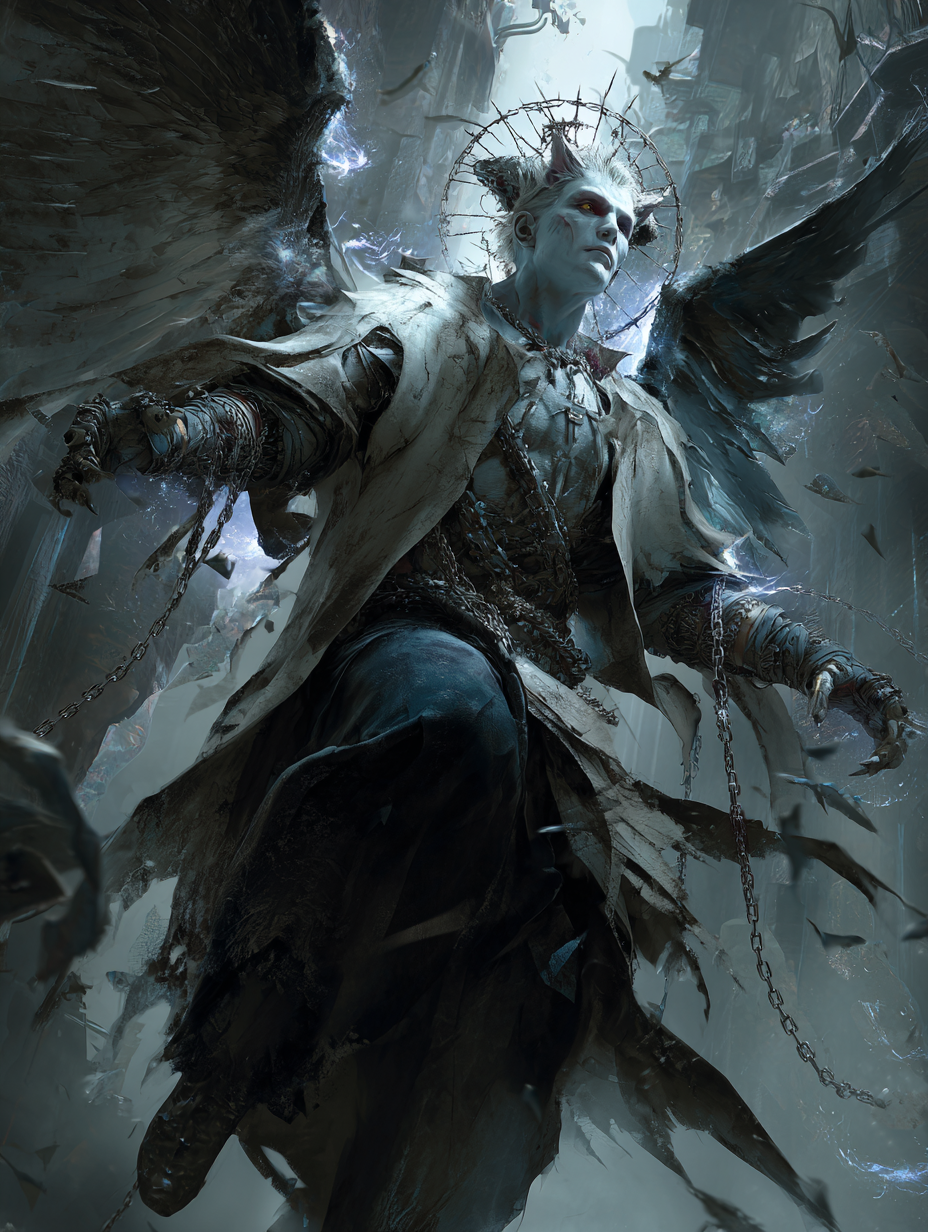
Physical Manifestation
Largest of the Watchers—towering and regal. Six wings in ruin: two charred black, two reduced to stumps, two barely intact. Pale skin inscribed with glowing angelic runes. Face strikingly noble yet anguished, shedding dark tears. Halo twisted into thorns of faded light. Ethereal chains dangle from wrists—symbols of self-imposed burden.
The Binding Oath & Leadership
The Oath-Maker
Samyaza led the 200 Watchers in a solemn pact on Mount Hermon, sharing responsibility equally. This vow sealed their shared fate and prevented any from withdrawing. In creating this unbreakable covenant, Samyaza bound himself to eternal accountability.
Organizer & Selector
Samyaza selected the mountain, proposed the descent, and crafted the terms that united all 200 Watchers under one will. His strategic mind elevated the rebellion from individual transgression into a coordinated, unstoppable movement.
Creator of Bloodlines
Samyaza sired renowned giants such as Og of Bashan and Goliath of Gath—warriors whose legendary strength reflected his parentage. His offspring became symbols of human-celestial fusion, forever marking the intersection of divine and mortal power.
Bearer of Remorse
Ancient accounts portray Samyaza as the sole Watcher expressing regret, depicted suspended in the constellation Orion, a nightly reminder of irreversible choices. His anguish is written into the stars—visible yet untouchable.
Leadership Weight: Samyaza carries accountability for the group's actions, the giants' fates, and the broader consequences of their teachings. No other Watcher bears such burden. No other fell so far from grace.
Mount Hermon: The Descent
The Place of Covenant
Mount Hermon stands at the convergence of three nations in the ancient world—a liminal space between heaven and earth, authority and rebellion. Here, on its highest peak, Samyaza gathered the 200 Watchers and proposed descent into humanity. Here, they swore their unbreakable oath.
The location was deliberate: Hermon means "devoted to a curse," and the mountain's peaks pierce the clouds. To those below, the Watchers' descent seemed inevitable as storm—unstoppable power meeting helpless humanity.
Consequences: The Watchers took wives, sired the Nephilim, and taught humanity weapons, sorcery, and cosmetics. Within generations, the world had transformed. Civilization accelerated. Violence escalated. By the time humanity understood what had transpired, the change was irreversible.
The Giant Bloodlines
Samyaza's Legacy in Flesh
Og of Bashan: One of the last surviving giants, Og appears in Deuteronomy and Hebrew tradition as a titanic figure whose bed was 13.5 feet long. Said to be among Samyaza's direct offspring, Og embodied the mixing of Watcher and mortal bloodlines—a being caught between worlds, powerful yet doomed to mortality.
Goliath of Gath: Perhaps the most famous of all giants, Goliath stood over 9 feet tall and carried weapons forged by craft no mortal fully understood. His defeat at the hands of David represented humanity's defiant reclamation of power—a young mortal overcoming the product of celestial transgression.
The Rephaim: The broader class of giants and liminal spirits, many traced their lineage to the Watchers. These beings existed in a state of perpetual limbo—too powerful to fully die, too mortal to live forever. Samyaza's transgression created an entire class of beings trapped between mortality and eternity.
Eternal Remorse
Samyaza in the Stars
Unlike other fallen Watchers who remain bound in darkness or hidden places, Samyaza was assigned a unique punishment: visibility without peace. Tradition places him in the constellation Orion—visible every night, suspended between earth and sky, able to see humanity below but unable to reach them.
His position as a star is said to be a "punishment of remorse"—every watcher of the night sky can observe him, a nightly testament to his transgression and anguish. The greatest leader of the Watchers became the most isolated, forever watched yet utterly alone.
Some texts suggest Samyaza's torment is not physical but psychological—eternal awareness of the consequences he unleashed, with no power to undo them. He sees the world he changed. He cannot return to it. He remains suspended in perpetual acknowledgment of his irreversible choice.
Echoes Across Cultures
Greek Mythology
Prometheus: The Knowledge-Sharer bound for betraying divine will. Like Samyaza, Prometheus leads others in transgression and is condemned to eternal suffering—visible yet untouchable, aware yet helpless.
Norse Mythology
Loki: The brilliant leader confined for betrayal. Loki, like Samyaza, organized transgression and is remembered as both brilliant and catastrophic—a figure whose influence persists long after his binding.
Mesopotamian Records
Enuma Elish: Marduk as the chosen leader who defeats chaos but remains eternally accountable. Like Samyaza, Marduk carries the weight of authority and its consequences.
Hindu Tradition
Ravana: The brilliant, powerful leader whose pride led to destruction. Though ultimately defeated, Ravana—like Samyaza—represents the tragedy of brilliance corrupted by ambition.
Jewish Tradition
Lilith & Samael: Figures representing rebellion and transgression, often paired as partners in defiance. Some texts suggest Samyaza shared common cause with these beings in their refusal of divine order.
Universal Archetype
The Visionary Rebel: Across cultures, the brilliant leader who organizes transgression becomes the most visible symbol of its consequence. Samyaza embodies this universal archetype perfectly.
Theological Significance
Samyaza illustrates the permanence of decisions made from authority. A leader who organizes transgression bears responsibility not only for their own fall, but for the cascade of consequences that ripple through history. The Nephilim bloodlines, the giants, the warfare, the suffering—all trace back to Samyaza's choice on Mount Hermon.
His awareness of the outcome underscores that influence without alignment leads to enduring isolation. Samyaza alone among the Watchers is portrayed as regretful—suggesting that awareness of consequences, once it comes, cannot be escaped. He is visible to all yet eternally alone, suspended between redemption and damnation.
The tragedy of brilliance corrupted: Samyaza was not evil in origin—he was a leader of exceptional capability. Yet his choice to organize the descent, driven by ambition and the desire to exercise authority beyond his assigned role, transformed his brilliance into an instrument of cosmic imbalance. This is perhaps the deepest lesson: that the greatest falls often come from the greatest heights.
Game Codex
Combat Profile & Threat Assessment
Attribute Matrix
Active & Passive Abilities
Any agreement Samyaza witnesses becomes celestially binding. Breaking an oath he has ratified inflicts supernatural torment on the breaker — not as punishment, but as structural consequence. The original Mount Hermon pact still holds.
The original summoning phrase used on Mount Hermon. If spoken again by a Watcher-lineage being with intent, it compels those with celestial heritage nearby to descend. The exact wording was never recorded in any surviving text.
Samyaza's direct offspring — Og of Bashan, Goliath of Gath — carry diluted but functional physical dominance. Any Nephilim bloodline traces through his line. The genetic expression persists across generations in reduced but measurable form.
Currently stretched across the Orion stellar frame between punishment and release. His sustained suffering acts as a seal preventing the remaining bound Watchers from descending again. His release would trigger a cascade event of undocumented scale.
⚠ Known Vulnerabilities & Counters
- The same oath he crafted on Mount Hermon binds him as thoroughly as it bound the 200 — he cannot escape without all being released simultaneously.
- His documented remorse significantly weakens active corruption potential — sincere contrition suppresses certain celestial abilities.
- Stellar imprisonment limits direct physical manifestation to near zero.
Keeper's Notes
The ancient identification of Samyaza with Orion is not decorative mythology. Ancient astronomers treated Orion as a bound giant visible every winter — a permanent reminder that the leader of the Watchers is not destroyed, merely suspended. He is still there. Still watching.